
NDIA Impairment Categories guide
A document called the Impairment Categories Guide is used by NDIA staff when making access decisions and recording your impairments.
It is an internal guide, not an official NDIS rule, so it should be treated as a reference for how the NDIA may make these decisions (treat it as a working tool rather than a published rule).
Its job is simple. A delegate has evidence of a diagnosis in front of them. This guide tells them which impairment category they must select, and which ones they may add.
These are the 6 Impairment Categories
- Intellectual: Affects communication, memory, and problem-solving.
- Cognitive: Affects learning, attention, and decision-making capabilities.
- Neurological: Involves the nervous system, impacting coordination or movement.
- Sensory: Affects hearing or vision (including partial or full loss).
- Physical: Limits structural movement, energy levels, speed, or physical stamina.
- Psychosocial: Functional impacts stemming from mental health conditions.
Required and optional impairment categories
Every condition in the guide gets two things.
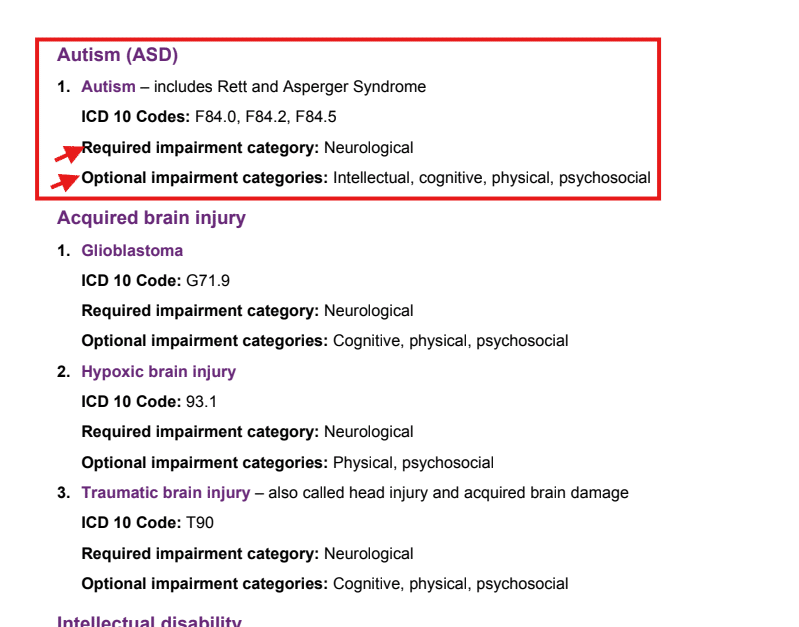
- A required category, which the delegate must select.
- And a list of optional categories, which may be added if the evidence supports it.
Optional categories are not automatic. They depend entirely on whether the evidence you supplied with your access request showed that impairment. No evidence, no category.
This means 2 people with an identical diagnosis can end up with very different notices, purely based on how thorough their paperwork was on the day. That is the single most useful thing to take away from this article.
How NDIS diagnoses map to impairment categories
Here are some of the conditions from the guide:
| Condition | Required category | Optional categories |
|---|---|---|
| Autism, including Rett and Asperger syndrome | Neurological | Intellectual, cognitive, physical, psychosocial |
| Cerebral palsy | Physical | Intellectual, cognitive, neurological, sensory |
| Down syndrome | Intellectual | Cognitive, physical |
| Stroke | Physical | Cognitive, neurological, sensory, psychosocial |
| Multiple sclerosis | Neurological | Cognitive, physical, psychosocial |
| Schizophrenia | Psychosocial | Cognitive |
| Hearing loss | Sensory | Cognitive |
| Visual impairment, including blindness | Sensory | None |
| Spinal cord injury, incomplete | Physical | Neurological, sensory, psychosocial |
| Dyslexia | Cognitive | Psychosocial |
A few things stand out.
- Cerebral palsy has no psychosocial option.
- Down syndrome has only two options and sensory is not one of them, despite how common hearing and vision issues are.
- Stroke has one of the widest maps in the guide, with almost everything available on evidence.
Conditions that map to an unexpected impairment category
The guide groups conditions under familiar headings, then sometimes sends them to a different category entirely.
- Spina bifida is listed under the intellectual disability heading, but the required category is physical.
- Tourette syndrome is listed under psychosocial disability, but the required category is neurological.
- Alzheimer’s disease is listed under other neurological, but the required category is cognitive.
- Foetal alcohol spectrum disorder sits under intellectual disability, but the required category is neurological.
If you have ever wondered why a notice says something that does not match how the condition is usually described, this is often why.
For your Curiosity
Required impairment categories
We counted every entry in the guide. Ninety four conditions in total.
Here is how many times each category was use:
| Impairment category | Times required | Share |
|---|---|---|
| Physical | 32 | 34% |
| Intellectual | 21 | 22% |
| Neurological | 17 | 18% |
| Psychosocial | 10 | 11% |
| Cognitive | 8 | 9% |
| Sensory | 6 | 6% |
| Total | 94 | 100% |
Physical is the workhorse. It is the required category for a third of everything listed, which makes sense once you notice how many chronic health conditions appear in the guide.
Renal failure, chronic lung disease, lupus, osteoarthritis, fibromyalgia and lymphoedema are all in there.
Optional impairment categories
Here is how many times each category appears as an optional category on across those same 94 conditions.
| Impairment category | Times available as optional |
|---|---|
| Cognitive | 53 |
| Psychosocial | 40 |
| Physical | 37 |
| Sensory | 29 |
| Neurological | 24 |
| Intellectual | 6 |
Two things jump out.
- Cognitive is listed as an optional category for 53 of the 94 conditions in the guide.
This means that if your disability falls within those 53 conditions, cognitive may be added to your impairment notice if your evidence shows that your disability affects your memory, thinking, planning, problem-solving or attention
- Intellectual impairment is the required category for 21 of the 94 conditions, and is only optional for 6.
This means it is much more commonly assigned as the main impairment category than added as an extra category.
NDIS conditions with only one impairment category
Twenty of the 94 conditions have no optional categories at all and only o required category. These include:
- Visual impairment including blindness, albinism and congenital eye conditions
- Rheumatoid arthritis, osteoarthritis, ankylosing spondylitis and lupus
- Chronic lung disease and COPD
- Renal failure
- Ehlers Danlos syndrome
- Obsessive compulsive disorder and borderline personality disorder
- Early onset dementia and rapidly progressing dementia
Under the 2026 reform Bill, where supports must directly arise from a listed impairment, a single category notice is a much narrower base to build a plan on.
If one of these is the only condition on a notice, that is worth a conversation now rather than at the next plan reassessment.
Limits of the impairment categories guide
It is a staff tool, not the law.
The document itself says it is not approved for use outside the agency’s system. It guides decisions. It does not make them.
It is a snapshot from October 2024. Internal guidance gets revised. What delegates are working from today may differ.
It does not decide access. The guide tells a delegate which categories to select for someone who has already met the eligibility requirements.
Whether you meet those requirements is a separate assessment.
Not every condition is in there.
How to use the impairment map
If you are a participant or family member, find your diagnosis in the list. Look at the optional categories. Ask yourself honestly whether any of them describe something you live with day to day that is not showing up in your plan.
If you are a support coordinator, use it as a gap finder. When you are preparing for a reassessment, compare the categories on the notice against the optional ones available for that diagnosis. The difference between the two is where the missing evidence usually sits.
If you are a provider, know which category your service naturally attaches to, then check it appears on the notices of the participants you support.