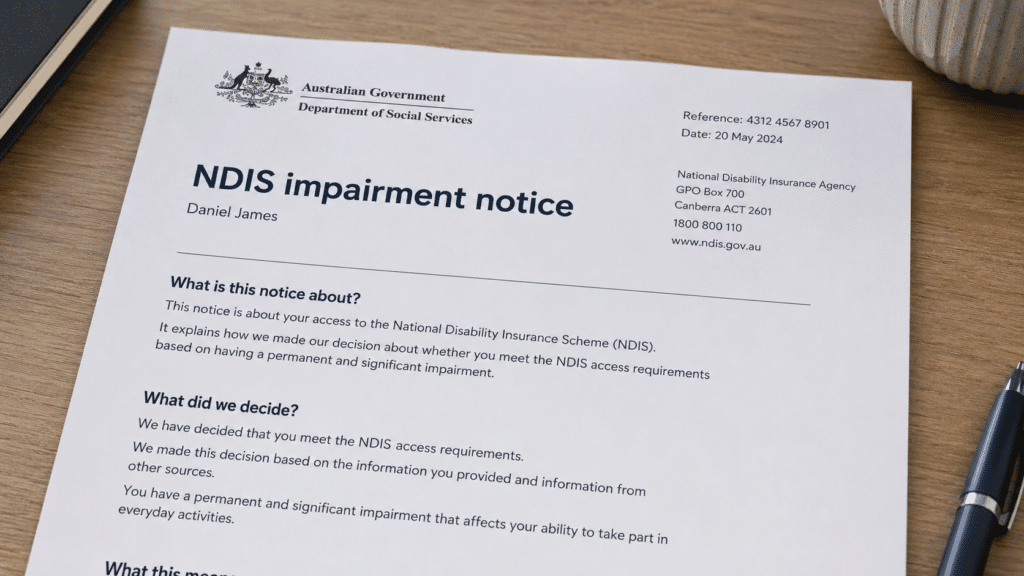
There is a short document sitting in your NDIS file that most participants have never read.
It does not list your diagnoses. It lists categories. These categories decide what your plan is allowed to pay for.
In this resource we will walk through what an impairment notice actually is, why it has quietly become one of the most important pieces of paper in the scheme, and the exact steps to find out what yours says.
Diagnosis is not the same as impairment
A diagnosis is the name of your condition. For example: Cerebral palsy, Multiple sclerosis or Bipolar disorder.
An impairment is the effect a condition has on how your body or mind works.
For example: Difficulty with balance, forgetting steps, finding it hard to focus, communicate or manage everyday routines.
The NDIS does not fund your diagnosis. It funds the support you need because of the impairment.
This means that 2 people can share the exact same diagnosis and have completely different plans, because the diagnosis is the label and the impairment is the reality.
So what is an impairment notice?
An impairment notice is a formal notice from the NDIA, given under section 32BA of the NDIS Act. It tells you which categories of impairment cover the impairments you met the disability requirements or the early intervention requirements for.
Your notice will not name your specific impairments. The Department’s own explanatory document for the notice rules says a notice will not identify the participant’s specific impairments, but rather the relevant category or categories of impairment.
So you will not see a paragraph describing your situation. You will see a short list of category names. That is the whole document.
Alternatively, for a child who meets the early intervention requirements because of developmental delay, the notice will say the participant has developmental delay instead.
Impairment notices were introduced by the Getting the NDIS Back on Track No. 1 Act 2024, which commenced on 3 October 2024.
NDIS Impairment categories
There are six impairment categories:
- intellectual
- cognitive
- neurological
- sensory
- physical
- impairments to which a psychosocial disability is attributable
More than one can apply to you. Your notice may list multiple impairment categories, but not every condition will necessarily be listed, as only impairments that meet the NDIS access requirements will appear on your notice.
Do you already have an Impairment Notice?
Depends when you applied.
- If you applied on or after 1 January 2025, your notice should have come with your access decision. The law requires it to be given as soon as practicable after your access request is decided.
- If you became a participant before 1 January 2025, you probably have not received one yet.
Draft rules released for public consultation in January 2026 would require the NDIA to give a notice to every participant who became a participant through an access request made before 1 January 2025, with the agency managing a staged rollout.
The explanatory document states that all participants will receive a notice of impairments before they transition to a new framework plan.
Whether you already have the notice, or will be receiving it soon, either way, the NDIA already holds a record of the impairments from your original access decision. You have simply not been shown it. We will get to how you can fix that.
You can ask for it to be changed
If you believe your impairment notice is missing a category, or includes a category that should not be there, you can ask the NDIA to change it.
Under subsection 32BA(5)(a)(i) of the Act, you can apply to vary your notice of impairments. That includes asking for a category to be added or asking for one to be removed.
Two things worth knowing.
- First, when you apply to add a category, the NDIA is required to look at your functional capacity holistically. The explanatory document is explicit about this.
A new impairment will not be assessed in isolation. The agency also has to consider how it interacts with your other impairments. - Second, when making a decision to vary, or not to vary, your notice is a reviewable decision under section 99 of the Act.
If you get a no, that is not the end of the road.
Your application has to be in the form the NDIA approves, and include whatever information and documents the agency requires.
You cannot apply while you already have an active variation application, or while a review of a variation decision is still running.
How to find out what impairments the NDIA has recorded for you
You have three ways in.
- Call the National Contact Centre on 1800 800 110. Ask what impairment categories are recorded against your access decision. This information is often enough to get you started. Staff can also submit an information request on your behalf if you ask them to.
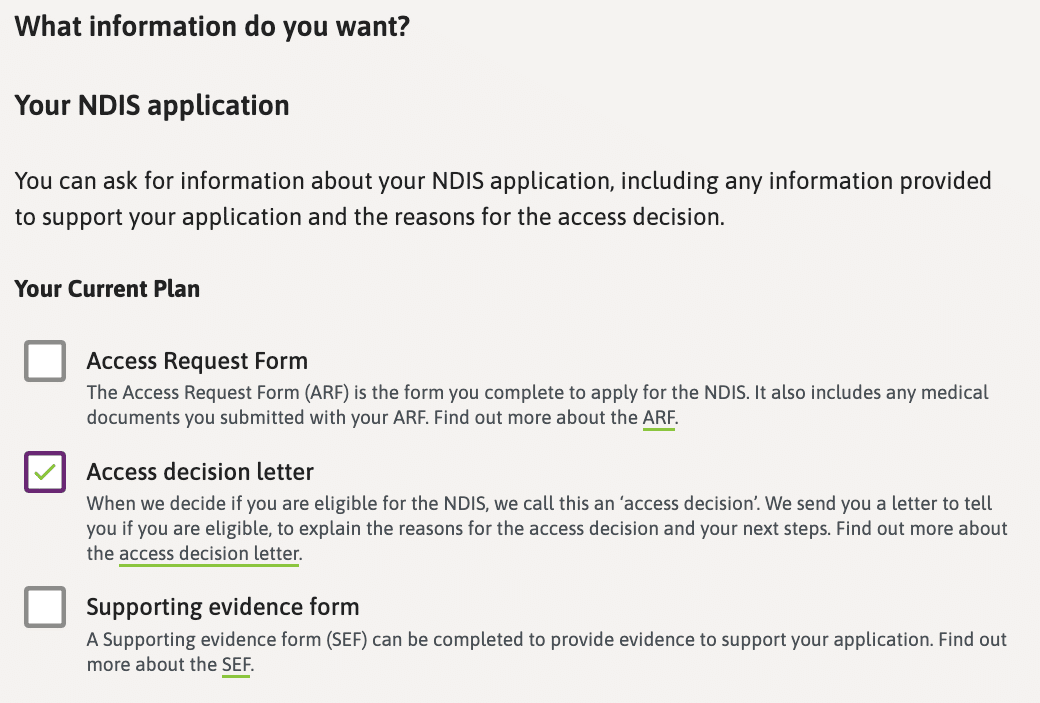
- Make a Participant Information Access request online. This is the formal path and it gets you documents rather than a verbal answer.
Use the PIA webform on the NDIS website. The form lists every document type the NDIA can release this way.
You must select the checkbox under ‘Your Current Plan’ that says ‘Access decision letter’
- Email information.access@ndis.gov.au.
The NDIA aims to provide the information within 28 business days, as long as your request meets its identity and consent requirements. If it does not, they will come back and ask.
Be aware they may close a request if the missing information is not supplied within 14 days, so keep an eye on your inbox after you lodge.
Who is allowed to ask?
A participant can request their own information. If you are a plan nominee or a child representative, you do not need to attach a consent form. Anyone else, including a support coordinator acting with the best intentions, needs to provide evidence of their authority or the participant’s signed consent.
What if I don’t agree?
Three scenarios cover almost everyone.
- The record looks right. No paperwork action needed. Your next steps shift to making sure the supports you are buying can be clearly linked back to the categories listed. When you write goals or service agreements, name the link.
- The record is right but thin. Very common. The category is there, but something that clearly affects your daily life is missing.
This is what the variation process exists for. You will need evidence from a treating professional, and the NDIS website has guidance on what evidence it accepts and which professionals it prefers. - Something you expected is not there at all. Move quickly on this one. Apply to vary the notice, with evidence showing the impairment meets the disability requirements or the early intervention requirements.
Remember the NDIA has to consider your functional capacity holistically, including how the impairment interacts with your others.
If the answer is no, it is reviewable. Loop in your support coordinator, your local partner in the community, or an independent advocate.
How a Specialist NDIS Plan Manager can help
At Plan Hero, we are already seeing participants receive their impairment notices.
If you are not sure whether you have one, or how to request a copy, we can walk you through it. We can also help you make sense of what your notice says, keep an eye on how your funding is tracking, and talk through whether a support you are considering is likely to sit within your plan.
We handle the invoices and the budget so you can spend your energy on the supports themselves.
Have a chat with one of our Plan Managers or go ahead and Join Plan Hero.