

The latest update to the NDIS Therapy Operational Guideline
The NDIS released a document called the ‘NDIS Therapy Operational Guideline’ on October 16 2025, which contains all the rules about the types of therapy supports available under the NDIS and the professions authorised to provide them.
This was an area of total confusion so we are pleased to finally have some firm rules for you.
Key Changes
This update is important because it clarifies what you can spend your therapy funding on based on what your NDIS PACE plan says
What does this update mean for you?
We now know that if you have specific therapy mentioned in your NDIS plan, you can only spend your therapy funding on that type of therapy.
We call this a STATED support.
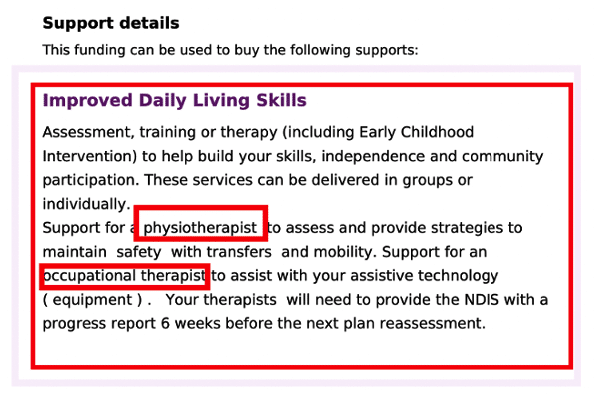
Here is an example of a STATED therapy support where this NDIS Participant can ONLY spend their therapy funding on a Physio and Occupational Therapy.
They cannot decide they would rather spend their funds on Psychology, even if it would help them achieve their goals.
Sometimes the NDIS does not mention specific therapies in an NDIS plan. We call this a FLEXIBLE support.
Here is an example where the NDIS plan has the generic NDIS blurb. This Participant can spend their therapy funding on ANY therapy the NDIS will fund that will help them achieve their goals.
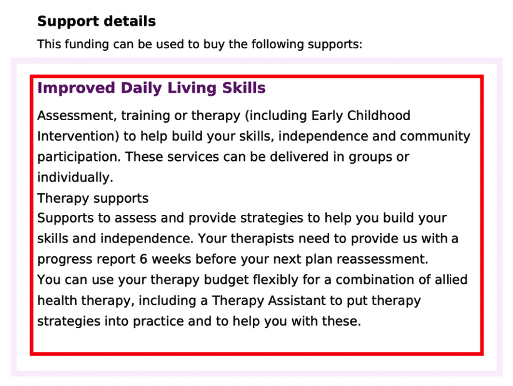
IMPORTANT NOTE: Both excerpts show the need for a progress report 6 weeks before the end of the plan. Make sure your therapist keeps funding hours to this.
How will these changes affect you
Plan Managed Participants
If your NDIS PACE plan has stated therapy supports, your Plan Manager cannot pay for any other therapy. There are no exceptions, even when it seems like the NDIS has made an error!!
If your NDIS plan has specific therapy named in it, your Plan Manager can only pay for that therapy. Even if it feels like the NDIS has made a mistake!
You will be out of pocket and have to pay for the therapy yourself.
Self Managed Participants
If your NDIS PACE plan has stated therapy supports and you claim for it, the NDIS could:
- Make you pay back the amount AND
- change your plan to being Plan Managed with no warning (we have seen this happed).
Agency Managed Participants
If your NDIS PACE plan has stated therapy supports and you engage a provider to deliver a different therapy, the NDIS WILL NOT pay the therapy provider.
The therapy provider will look to you to settle their fees.
If your plan has stated therapy supports, we cannot pay for any other therapy. There are no exceptions, even when it seems like an error!!
We can only pay for the therapy type printed in your plan. Make sure you read your plan carefully or share your plan with your therapist so that you don’t receive therapy you can’t pay for.
If you don’t have any therapies mentioned, we can pay for any therapy that the NDIS will fund, provided it’s delivered by the appropriate professional.
What happens if you need to change the therapy funding you have?
You will need to contact the NDIS and request a plan reassessment or change of circumstances. You will need to provide evidence as to why you need different therapy and it will take ages to change if the NDIS agrees.
Read the actual update (long version)
The Therapy Operational Guideline now reads:
“What happens when you get therapy supports in your plan?
Your plan may include some therapy supports which are funded by us and some by another service, such as the health system. When you have funding for therapy supports in your plan, you can use your funding to get the NDIS supports you need, in line with your plan. If you need help to use your funding, talk to your “My NDIS Contact”, support coordinator or recovery coach.
We include therapy supports in your plan as a stated support under the Improved Daily Living Skills support category. This means you can only use this funding for therapy. You can’t use your therapy funding flexibly to pay for other capacity building supports. Learn more about how we describe supports in your plan.
Your plan may include funding for therapy supports without describing a specific therapy type. This means you have the flexibility to choose your provider, and where appropriate, the type of therapy that suits your needs. This gives you greater choice and control over the therapy type you choose, and who delivers the therapy. You can choose if you want to spend your therapy funding on:
• individual or group sessions
• intensive blocks of therapy, or therapy at regular intervals
• a particular therapy, or combination of therapies, that will be most effective in meeting your needs at a certain time.
In some plans we may include extra details, such as a specific stated therapy type or a measurable outcome you want to achieve. When we do this, you must use your funding in the way we describe in your plan. This helps make sure you use the funding for its intended purpose.
Source: NDIA Therapy Supports Operational Guideline – Page 18 and 19