
The NDIA has released the Annual Pricing Review for 2026-27 and the new NDIS Pricing Schedule 2026-27.
Important things to note:
- This is not the 2026-2027 Support Catalogue (NDIS pricelist) but rather a summary of pricing changes that are happening on 1 July 2026 or have been recommended.
- The prices in the new Pricing Schedule document are firm and active from 1 July 2026.
- This update matters if you are an NDIS provider, participant, parent, carer, Support Coordinator or Plan Manager.
- Some prices have changed and some have stayed the same.
- How providers charge for things like therapy has changed as there are new support line items that providers will need to use in their invoices.
The final Pricing Arrangements and Price Limits and Support Catalogue for 2026-2027 may still provide more operational detail, such as claiming rules, support item use and system instructions. But the prices in the released Pricing Schedule should be treated as active from 1 July 2026.
Quick Summary of the 2026-27 NDIS Price Changes
| Support area | What changed? | Why? |
|---|---|---|
| Disability Support Worker supports | Indexed/increased | Adjusted to reflect SCHADS Award wage changes. |
| Nursing supports | Increased | Reflects wage growth and inflation. |
| Psychologists | Increased | Aligned with Medicare and private health benchmarks. |
| Dietitians | Reduced | NDIS pricing was higher than comparable market rates. |
| Exercise Physiologists | Reduced | Aligned more closely with benchmark pricing. |
| Orientation and Mobility Specialists | New dedicated price | Improves claiming accuracy and recognises OMS as a distinct profession. |
| Other Professionals | Reduced | Limited evidence to support a higher broad category price. |
| Support Coordination | Remain unchanged | Current prices were found to remain appropriate. |
| Psychosocial Recovery Coaching | Indexed/increased | Pricing remains linked to the Disability Support Worker Cost Model. |
| Plan Management | Unchanged monthly fee | Need to find out more about the administrative and transactional costs of Plan Management. |
| Social, Community and Civic Participation | Registered providers unchanged. Unregistered providers reduced from 1 January 2027. | Reflects different provider obligations and market structures. |
| Short Term Accommodation | Pricing structure changed | Accommodation and support costs will be separated. |
| Isolated towns | New framework | Supports access in thin markets with long travel times and low plan use. |
Disability Support Worker Supports
Disability Support Worker rates have been indexed/increased. This means they have been increased in line with wage and cost changes.
This increase applies to:
- support worker rates
- Supported Independent Living (SIL) rates
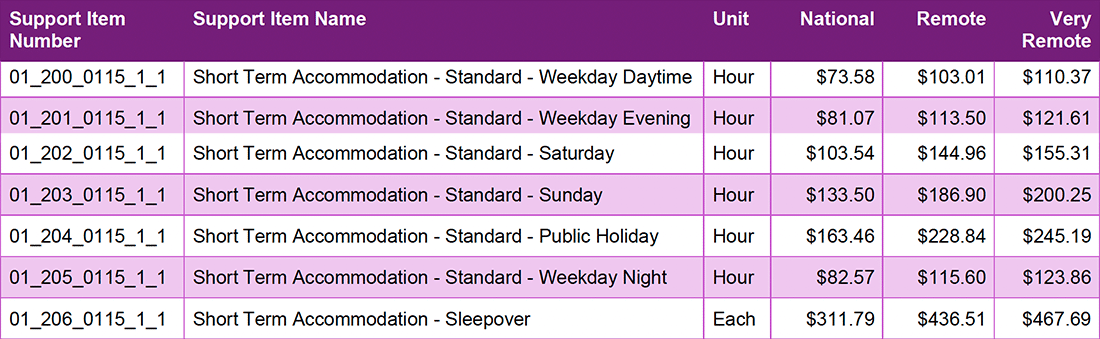
- Short Term Accommodation support hours
- psychosocial recovery coaching
Short Term Accommodation Changes
Short Term Accommodation, often called STA or respite, has a major pricing structure change.
The NDIA is moving away from a ‘bundled’ single daily price.
Instead, STA pricing now separates:
- participant accommodation
- support worker accommodation
- support worker hours
- high intensity support loadings where applicable
Support worker rates now include line items for support delivered as part of STA:
Nursing Rates
The hourly rates for nursing have increased by around 3.56% from 1 July 2026, with the standard Registered Nurse weekday daytime national rate moving from $123.65/hr to $128.05/hr.
Nursing is not covered by the Disability Support Worker (DSW) Cost Model, so the NDIA have called it out separately.
Therapy Supports
Therapy pricing has had some of the biggest changes.
Most prices have remained unchanged, see below the prices that have changed.
| Therapy support | 2026-27 National Price | Change |
|---|---|---|
| Psychologist | $252.99 per hour | Increased |
| Dietitian | $178.99 per hour | Reduced |
| Exercise Physiologist | $161.99 per hour | Reduced |
| Orientation and Mobility Specialist | $156.16 per hour | New dedicated line item and rate |
| “Other Professionals” | $156.16 per hour | Reduced |
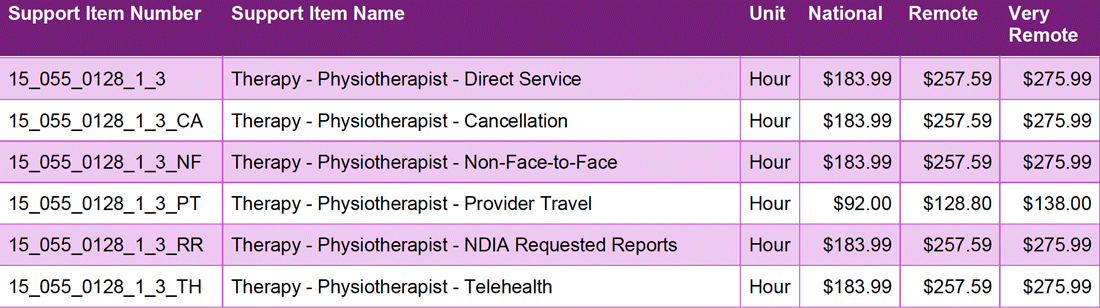
New Therapy Claiming Line Items
The new Pricing Schedule separates therapy claim types more clearly.
- direct service
- cancellations
- non-face-to-face work
- provider travel
- NDIA requested reports
- telehealth
Support Coordination
Support Coordination prices have stayed the same.
Psychosocial Recovery Coaching
Psychosocial Recovery Coaching has been indexed because pricing remains linked to the Disability Support Worker Cost Model. From 1 July 2026 it will be increased.
Plan Management
The Plan Management monthly fee has stayed the same. The monthly fee is still:
$104.45 per month
Note that Plan Management fees do not affect participant plans as they come from a separate bucket of funding (stated supports) and cannot be used for anything else.
The NDIS will undertake a review of the Plan Management pricing approach (no suggested timeline) to make sure price guidance and recommendations align with the how Plan Management is delivered in practice.
Social, Community and Civic Participation
There is a major change coming for Social, Community and Civic Participation supports from 1 January 2027.
The main change is price differentiation based on registration status:
- For registered providers, prices stay the same and indexation (increase in prices every year) continues.
- For unregistered providers, prices for Social, Community and Civic Participation supports will be reduced by 10% from 1 January 2027, including high-intensity supports.
Indexation for unregistered SCCP supports will also stop which means the differential will increase each year.
This applies across the relevant SCCP items, including standard and high-intensity supports, PLUS related claiming such as non-face-to-face support, provider travel, short-notice cancellations and activity-based transport.
The reasoning is that the NDIA believes that registered providers have higher governance, workforce and compliance obligations.
Isolated Towns and Remote Areas
The NDIA will continue to provide pricing support for isolated/remote areas.
The complicated stuff is below:
The NDIA is keeping the existing Isolated Towns Modification, but splitting it into a clearer Type 1 / Type 2 framework.
Type 1 Isolated Towns are the existing isolated towns. These will continue to have their Modified Monash category treated as MM6, meaning the relevant remote loading and travel arrangements continue.
The definition is being updated so it covers towns that are either surrounded by remote/very remote areas or require travel through remote/very remote areas.
Type 2 Isolated Towns are a new category. Providers in these locations will be able to negotiate travel costs with participants, but no additional price loading applies.
To qualify as Type 2, a location must generally be MM4 or MM5, have average SA2 plan utilisation of 60% or less over 3 years, be 70+ minutes from the nearest MM1/2/3 area, and have a SEIFA disadvantage score of 5 or below.
What Providers Should Do Now
If you are an NDIS provider, you should:
- check the new NDIS Pricing Schedule for your support items
- update your service agreements where prices are changing
- explain any price changes clearly to participants
- make sure participants agree before changes apply
- review your invoices and claiming systems
- check whether new line items apply to your supports
- keep an eye out for the final Pricing Arrangements and Support Catalogue for detailed claiming rules
What Participants Should Do Now
If you are a participant, parent or carer, you should:
- ask providers if their prices are changing
- check whether your service agreement needs updating
- ask providers to explain travel, report writing and non-face-to-face charges
- watch for changes in STA invoices
- speak with your Plan Manager if you are unsure about an invoice
We speak to participants and families every day who are trying to understand whether a provider invoice is correct.
You do not need to know every line item yourself. But it helps to know what has changed, what questions to ask, and when to get help.
How Plan Hero Can Help
Plan Hero helps participants, parents and carers understand their NDIS budgets, invoices and provider claims.
Our Plan Managers track your budgets, process invoices and help you understand what can be claimed under your plan.
We can help you understand:
- whether an invoice has the right information
- whether a provider is charging within the NDIS price limits
- how your budget is tracking
- whether a service agreement reflects the new pricing
- what questions to ask your provider before agreeing to changes
But we can help you understand the financial side of your plan so the NDIS feels less confusing.
References: