
If you or someone you care for is blind or has low vision, you may have heard the term Orientation and Mobility Specialist, or OMS.
It can sound technical, but the role is very practical.
An OMS helps people who are blind or have low vision move around safely, confidently and independently.
This may include learning how to use a white cane, travel to school or work, cross roads safely, use public transport, or move through familiar and unfamiliar places with more confidence.
It was recognised by the NDIS Quality and Safeguards Commission in March 2025 when it decided to introduce dedicated OMS support line items to improve claiming accuracy.
What is an Orientation and Mobility Specialist?
An Orientation and Mobility Specialist helps people who are blind or have low vision understand:
- where they are,
- where they want to go, and
- how to get there safely.
Orientation means knowing where you are in your environment.
Mobility means moving safely from one place to another.
Together, orientation and mobility support can help a person build independence in everyday life.
This might be at home, school, work, university, shops, public transport, or in the community.
What does an OMS do?
An OMS works with the person to understand their vision, confidence, environment, safety needs and daily routines.
They then teach practical travel and navigation skills.
An OMS may help with:
- white cane training
- safe road crossing
- using public transport
- learning routes to school, work or local shops
- moving safely around the home
- navigating school, TAFE, university or workplace settings
- building confidence in unfamiliar places
- using landmarks, sound and touch to understand surroundings
- using accessible navigation apps or GPS tools
- developing travel plans and safety strategies
The support is usually very hands-on.
For example, an OMS might walk a route with a participant several times until the participant can complete it with less support.
A simple example
A teenager with low vision is starting high school.
They feel anxious about finding classrooms, moving through busy corridors and getting from the bus stop to the school gate.
An OMS may work with them before school starts to:
- learn the school layout
- practise safe walking routes
- identify landmarks
- build confidence using the bus stop
- develop strategies for crowded or noisy areas
The goal is not just getting from one place to another.
The goal is confidence, safety and independence.
Who might need an OMS?
An OMS may support children, teenagers or adults who are blind or have low vision.
They may also support people whose vision is changing over time.
A person may benefit from an OMS if they:
- are blind
- have low vision
- have a progressive vision condition
- feel unsafe or anxious when travelling
- need help learning new routes
- need support using a white cane
- need help accessing school, work or the community
- have had a recent change in vision
- need to build confidence travelling independently
The focus is not just on the diagnosis.
It is about how vision loss affects everyday life, independence and community participation.
Conditions where OMS support may be helpful
OMS support may be helpful for people with conditions such as:
- Retinitis Pigmentosa
- Stargardt disease
- glaucoma
- macular degeneration
- optic nerve conditions
- cortical vision impairment
- congenital vision impairment
- vision loss after illness, injury or surgery
- dual sensory impairment
This is not a complete list.
If vision loss affects a person’s ability to move around safely or take part in daily life, OMS support may be worth discussing.
What qualifications should an OMS have?
Orientation and Mobility Specialists complete specialised training in vision impairment, safe travel, mobility instruction and environmental access.
Many practitioners in Australia are connected with the Orientation and Mobility Association of Australasia.
You may also hear the term ROMSA, which means Registered Orientation and Mobility Specialist Australasia.
When choosing an OMS, it is reasonable to ask:
- What qualifications do you hold?
- Are you a member of OMAA?
- Are you registered as ROMSA, or working towards it?
- What experience do you have with my vision condition?
- Do you work with children, adults, or both?
- Can you provide reports for NDIS planning or reassessment?
A good provider should be able to explain their qualifications and experience clearly.
Can the NDIS fund Orientation and Mobility support?
Yes, the NDIS may fund Orientation and Mobility support where it is related to the participant’s disability and meets the NDIS funding criteria.
OMS support may help a participant:
- increase independence
- build daily living skills
- access the community safely
- participate in education or employment
- reduce reliance on family or informal supports
- develop confidence using public transport
- move safely through home, school, work or community settings
The support should connect to the participant’s NDIS goals.
For example, if a participant has a goal to travel more independently, access work, attend school, or participate in the community, OMS support may help them work towards that goal.
Which NDIS budget category is used?
NEW!! From 1 July 2026, OMS supports have a dedicated NDIS line items and a national maximum price of $156.16 per hour, with separate claim lines for direct service and other activities like travel and non face-to-face charges where applicable.
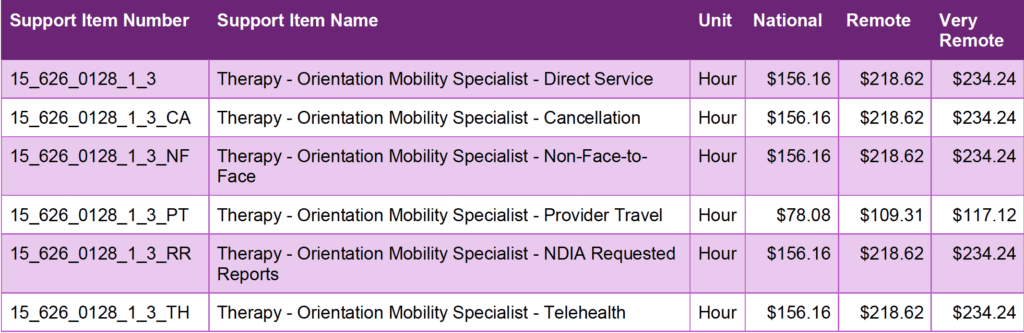
OMS can access standard secondary supporting claim typeslisted in the pricing schedule, such as:
- provider travel
15_626_0128_1_3_PT
Therapy – Orientation Mobility Specialist – Provider Travel
- non-face-to-face
15_626_0128_1_3_NF
Therapy – Orientation Mobility Specialist – Non-Face-to-Face
- cancellations
15_626_0128_1_3_CA
Therapy – Orientation Mobility Specialist – Cancellation
- NDIA requested reports
15_626_0128_1_3_RR
Therapy – Orientation Mobility Specialist – NDIA Requested Reports
- telehealth
15_626_0128_1_3_TH
Therapy – Orientation Mobility Specialist – Telehealth
Provider travel for OMS is priced at 50% of the direct hourly rate, so $78.08 per hour nationally which must be billed separately as there is a separate line item for it. See above.
What should participants ask about pricing?
We often see participants surprised by travel charges, report-writing costs or non-face-to-face charges.
Before starting OMS services, ask the provider:
- What hourly rate do you charge?
- Which NDIS line item will you use?
- Do you charge for travel time?
- Do you charge travel kilometres or other travel costs?
- Do you charge for reports?
- Do you charge for non-face-to-face work?
- Will these charges be written into the service agreement?
These costs should be explained before services begin.
If you are plan managed, your Plan Manager can help you understand whether an invoice has the right information and whether it fits within NDIS pricing rules.
Can an OMS charge for travel?
In some situations, yes.
Provider travel may be claimable if the NDIS Pricing Arrangements allow it for the relevant support item and the participant has agreed to it in advance.
This may include travel time and reasonable non-labour travel costs, depending on the rules that apply.
Travel should be discussed clearly before supports start.
Can an OMS charge for reports?
In some situations, yes.
Reports may be claimable where they are connected to the support being delivered and the current NDIS Pricing Arrangements allow that claim type.
For example, an OMS may prepare a report about a participant’s mobility needs, progress, safety risks, or recommendations for future supports.
Before agreeing to a report, ask:
- Why is the report needed?
- How long will it take?
- What will it cost?
- Which budget will it come from?
- Will it support my NDIS reassessment or funding request?
How OMS support can help with NDIS goals
OMS support often links strongly to NDIS goals around independence, safety and community participation.
Examples of NDIS goals may include:
- I want to travel to school more independently.
- I want to use public transport safely.
- I want to build confidence accessing my local community.
- I want to reduce my reliance on family for transport.
- I want to learn safe travel routes to work or study.
- I want to move around my home and community more safely.
Good evidence will explain how the OMS support helps the participant work towards these goals.
What evidence may help?
If you are asking for OMS support in your NDIS plan, evidence can help show why the support is reasonable and necessary.
Useful evidence may include:
- functional vision assessments
- reports from an OMS
- reports from an orthoptist, ophthalmologist or optometrist
- school or workplace information
- examples of safety concerns
- information about transport barriers
- details about current reliance on family or carers
- goals linked to independence, education, work or community access
The most helpful evidence explains how vision loss affects everyday life.
Questions to ask before choosing an OMS
Choosing the right OMS can make a real difference.
Before starting, you may want to ask:
- What experience do you have with my age group or condition?
- Do you provide support at home, school, work or in the community?
- Can you help with public transport training?
- Can you help with white cane training?
- How do you measure progress?
- Do you provide written reports?
- What are your fees?
- Do you charge travel?
- How will your support connect to my NDIS goals?
The bottom line
An Orientation and Mobility Specialist helps people who are blind or have low vision move around safely, confidently and independently.
They may support white cane skills, route learning, public transport, community access, school or workplace navigation, and safer movement at home.
OMS support may be funded through the NDIS when it is related to the participant’s disability, supports their goals and meets NDIS funding criteria.
Before starting services, ask about qualifications, pricing, travel, reports and the NDIS line item being used.
Clear information at the start can help you avoid confusion later.